
Emergency Air Duct Cleaning Near Me: What Santa Ana Homeowners Should Do First
If you’ve just discovered smoke, sewage, or rodents have gotten into your ductwork, shut your HVAC system off at the thermostat and leave it off. Don’t run the fan, don’t test the heat, don’t try to air anything out. Every minute air moves through a contaminated system, it pushes whatever got in deeper into the duct lining where it becomes exponentially harder to remove. After you’ve shut everything down, document what you see, call your insurance company, and then start calling contractors who carry professional-grade equipment like Rotobrush or Nikro systems, not a van with a shop vac. If you’d rather skip the research and talk to someone now, call (833) 620-2848.
The First 30 Minutes: A Triage Protocol by Contamination Type
What actually constitutes an “emergency” in ductwork falls into four categories in Santa Ana, and each one demands a slightly different first response. Getting this sequence right in the first half hour matters more than almost anything a cleaning crew does later.
Wildfire smoke intrusion. Santa Ana sits downwind of multiple fire corridors, and when smoke settles into a neighborhood, it doesn’t stay outside. Homes with attic-ducted HVAC systems pull smoke through ridge vents and eaves, and the blower distributes fine particulate through every register. Here’s the protocol: shut the system off at the thermostat, not just the breaker, because some modern thermostats trigger periodic fan cycles even without a heating or cooling call. Close all supply registers and return grilles. If you have a high-MERV filter installed, leave it in place; if you have a fiberglass “rock catcher” filter, don’t bother touching it, just wait for a technician.
Sewage backup. If a drain line backed up into a basement or crawlspace where ducts run, the immediate move is to contain the area. Shut the system off. Close interior doors to the affected space. Do not run any exhaust fans, because depressurizing the home can pull contaminated air through duct seams. Sewage-related contamination is the one scenario where you want a contractor with Abatement Technologies equipment or equivalent negative-air capability, not a standard cleaning package. The priority is keeping bioaerosols out of living spaces, not just removing odor.
Rodent infestation discovery. You opened a crawlspace access panel and found nesting material, droppings, or a chewed duct boot. First action: shut the system off and photograph everything before touching a single piece of debris. We’ve pulled nesting material out of a return plenum in a Santa Ana ranch house where the homeowner had swept up droppings before taking photos, and the insurance adjuster denied the claim because the scene was too disturbed to verify. Leave it in place. Document it. Then call someone.
Post-flood. Santa Ana’s soil doesn’t absorb water quickly, so localized flooding is more common than people expect in older neighborhoods with slab-on-grade construction and low duct runs. If water touched the exterior of insulated flexible duct or entered through a floor register, shut the system off and remove the register grate. Take photos of the water line on anything visible. Water-wetted fiberglass insulation inside ductwork cannot be dried and reused, full stop. Any contractor who says they’ll “dry it out” without cutting out and replacing the affected section is not doing you a favor.
Why Running the HVAC to ‘Air Things Out’ Makes Everything Worse
This is the mistake we see most often in Santa Ana homes after smoke events, and it’s the single most expensive error a homeowner can make in the first hour. The instinct to run the fan makes sense on the surface: you smell smoke, you want to push it out. But your HVAC isn’t an exhaust system. It recirculates air internally. Running it doesn’t expel contaminated air; it coats the inside of every duct, the blower wheel, the evaporator coil, and the heat exchanger liner with whatever you’re trying to remove.
Smoke particulate is especially punishing because it’s electrostatic. Fine soot particles carry a charge that makes them bond aggressively to duct surfaces. Each hour the fan runs, that bond becomes more permanent. What started as a top-and-return cleaning job becomes a full-system clean with coil cleaning and possible liner replacement. In some cases, we’ve seen smoke-impregnated flex duct that could not be cleaned at all and had to be physically replaced. That’s the difference between a $500 bill and a $2,000 one.
The same principle applies to sewage odors. Running the fan after a sewage event turns a localized concentration of bioaerosols into an evenly distributed one. You’re not removing anything; you’re wallpapering it through the system.
Restart timing isn’t a “wait 24 hours” blanket rule. It depends entirely on contamination type. Smoke contamination requires the system stay off until the ducts and coil have been mechanically cleaned. Rodent contamination requires the system stay off until all nesting material is removed and surfaces are sanitized, because HEPA vacuuming live droppings is a dangerous dust-mobilizing activity if the blower cycles. Post-flood, the system stays off until every water-wetted fibrous component is cut out and replaced. Dryer vent systems, if they were involved, follow the same logic: the vent is not a dryer, and running it won’t dry it out.
Documenting Everything Before Cleaning Begins: What Insurance Actually Needs
Insurance adjusters are not your enemy, but they do work from checklists. A claim for duct contamination lives or dies based on what you can prove was there before anyone touched it. Here’s what to capture before any cleaning contractor arrives in Santa Ana:
- Photos of the source event. The smoke-filled sky outside your window with the address visible if possible, the water line on the foundation, the rodent nest in place, the sewage stain. Timestamp metadata helps.
- Photos of HVAC components as found. Register faces showing soot streaking, the filter with visible particulate, the return grille with residue. Do not clean these first.
- A written log. Date and time you discovered the issue, date and time you shut the system off, what the system was doing before you shut it down, and any symptoms you noticed indoors (odor, respiratory irritation, visible dust at registers).
- Equipment details. Make, model, and approximate age of your HVAC unit and any in-duct accessories like Honeywell or Aprilaire air cleaners. If those brands were installed, note them. An adjuster will ask whether the air cleaner was damaged, and knowing the model speeds up the claim.
- Your contractor’s pre-cleaning assessment. A credible duct cleaning company should provide a written condition report before work starts, documenting what they found, what they observed in terms of contamination severity, and their recommended scope. This document carries genuine weight with adjusters because it’s an independent third-party record not tied to the homeowner’s account.
One more thing on insurance: some policies have specific language about “sudden and accidental” events versus gradual deterioration. A flood that happened yesterday is covered. Three years of accumulated cooking grease in ducts is not. If you’re not sure which bucket your situation falls into, document first and let the adjuster make that call. Don’t narrate your own claim into denial.
How to Vet a Contractor When Every Ad Says ‘Emergency Service Available’
Here’s the honest part. When you search “emergency air duct cleaning near me Santa Ana” at midnight, a portion of the results are canvassing operations and pressure-washing companies that added “duct cleaning” to their website because it’s profitable. They’re not bad people. They’re just not equipped for the job. Here’s how to filter them fast.
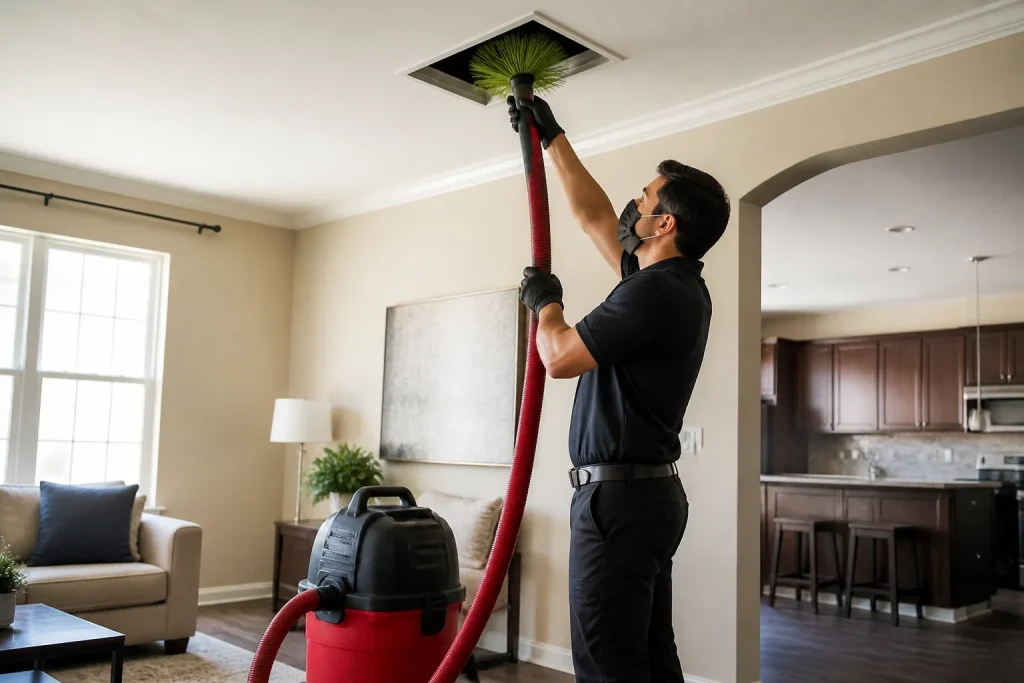
Ask what equipment they run. Listen for the names Rotobrush or Nikro. Those are professional-grade air duct cleaning systems built for commercial and residential work, with rotary brushes that mechanically agitate the duct liner rather than just vacuuming loose dust. If the answer is “we have a truck-mounted vacuum” with no mention of an agitation system, that’s a surface cleaning. It will not remove smoke-impregnated film or compressed nest material. It will make the registers look cleaner for two weeks and then the smell comes back.
Ask whether they can perform repairs if they find damage. Emergency scenarios involving rodents or flooding almost always involve physical damage to duct sections. A company that can only clean cannot fix what it finds, and you’ll end up coordinating a second contractor while your system sits idle. A company that does air duct repair in Santa Ana alongside cleaning can replace a chewed section or a flood-wetted flex run on the same call. That’s the difference between a two-day disruption and a two-week one.
Ask about their approach to the specific contaminant you’re dealing with. Smoke requires agitation plus HEPA-filtered collection. Sewage requires antimicrobial application and possibly negative air pressure to prevent cross-contamination during cleaning. A real professional will have a protocol for each scenario. Someone who says “we clean all kinds of ducts, we’ll figure it out when we get there” is being paid to learn on your job.
Ask whether they document their work with before-and-after photos of the actual ducts, not just register faces. The duct cleaning industry has a documented problem with claim verification, and a contractor who resists photo documentation of the work is telling you something.
What ‘Emergency Cleaning’ Can Fix, and What It Can’t
Let’s be precise about scope, because this is where homeowners in Santa Ana get disappointed. Duct cleaning is excellent at removing the following:
- Smoke particulate and soot film from duct interiors, when the ducts are non-porous metal or properly cleaned flex
- Dust, debris, and light construction debris that accumulated after a renovation
- Rodent nesting material and loose droppings, with proper HEPA collection and disposal
- Standing water and debris from duct interiors after floodwater ingress, provided the fibrous insulation was not saturated
Duct cleaning cannot fix the following, and any contractor who says otherwise is misleading you:
- Smoke-impregnated fiberglass duct liner. Once soot has bonded to fibrous insulation inside a duct, mechanical agitation will not remove it completely. That liner section must be cut out and replaced. We use Abatement Technologies equipment on remediation-level jobs precisely because it’s designed for this reality, not to pretend it away.
- Water-saturated flexible duct insulation. Wet fiberglass loses its R-value permanently and breeds mold. Cleaning it is not possible. It gets removed and replaced.
- Structurally compromised ductwork. If a section has collapsed, separated at a seam, or been chewed through to the point where the inner liner is compromised, no amount of cleaning restores function. It needs air duct repair.
- Contamination inside the HVAC unit itself. The coil, blower wheel, and heat exchanger liner require separate cleaning that some duct-only companies don’t perform. At Anvil, we work across the system: the duct pathways that carry air, the components that move it, and the hardware that controls it. Familiarity with brands like Honeywell and Aprilaire means we can work with whatever you have installed, not just the duct runs themselves.
When to call a pro rather than attempt even the documentary steps yourself: if you have respiratory symptoms that worsen inside the house, if you can smell smoke or sewage through closed registers, or if you’ve already tried running the fan and made things worse. The first two are health-level issues, and the third just changed the scope of cleaning. All three are phone calls to Anvil Air Duct Cleaning home territory, not DIY territory.
Why Santa Ana’s Climate Makes Duct Emergencies Worse Than You’d Expect
Santa Ana’s air quality profile is shaped by two forces that don’t exist in most of the country. First is the Santa Ana wind pattern itself, those hot, dry downslope winds that compress and heat as they descend from the high desert. Those winds carry fine particulate from wildfire zones and agricultural land into the basin, and Santa Ana’s older housing stock, much of it built before modern tight building envelopes, lets that particulate inside. Attic duct systems in 1950s and 1960s ranch homes are especially vulnerable because the ducts themselves often run through unconditioned space where air leakage is highest.
Second is humidity, which sounds counterintuitive for Southern California, but here’s the nuance. Santa Ana’s proximity to the coast means marine layer mornings with high relative humidity followed by dry afternoons. That daily cycle creates condensation inside poorly insulated duct runs, and condensation is what allows fine particulate to adhere. Dry particulate bounces. Damp particulate glues itself to the liner. By the time a homeowner in a Santa Ana neighborhood notices the musty smell or the soot streaking at registers, the contamination has been building for weeks.
This means emergency duct situations in Santa Ana are rarely one-time events. A smoke intrusion during Santa Ana wind season leaves behind particulate that resuspends on hot, dry days for months afterward. A post-flood duct problem leaves humidity issues that linger through the marine layer season. The right approach isn’t just an emergency visit; it’s the emergency visit plus a follow-up cleaning or air duct cleaning in Santa Ana after the environmental trigger has passed.
We pulled a duct liner out of a home near the Santa Ana Zoo last year where a homeowner had run their system for two days after a smoke event before calling anyone. The entire return plenum looked like it had been sprayed with a fine black coating. We could clean the metal sections, but the flex duct had to be replaced. That’s the cost difference between 30 minutes of patience and 48 hours of running the fan. It’s not a small number.
If your emergency involves the dryer vent as well, the same discipline applies. A dryer vent cleaning in Santa Ana after a smoke or dust event is straightforward if it hasn’t already accumulated lint into a blockage. But a vent that was already partially clogged and then took on smoke particulate is a genuine fire-risk situation per NFPA guidance, and it needs professional attention sooner than the ducts themselves.
The Bottom Line
Here’s the whole protocol compressed into something you can remember at 2 a.m. after you discover a problem: shut the system off, document what you saw, call your insurance company, and then call a contractor who carries professional-grade equipment and can repair what they find, not just clean around it. The first 30 minutes determine most of what happens next, and the most expensive decision you can make is running the fan to “clear the air.” It does the opposite.
If you’re in Santa Ana and facing a smoke, flood, sewage, or pest situation in your ductwork, Anvil Air Duct Cleaning offers free estimates and a straight answer about what’s cleanable and what isn’t. We run Rotobrush and Nikro systems on every job, we hold Abatement Technologies equipment in the lineup for remediation-level work, and we’ll tell you honestly if a section needs replacement instead of cleaning. Call (833) 620-2848.
Frequently Asked Questions
Shut your HVAC system off at the thermostat and leave it off. Do not run the fan, even in “fan only” mode. Close registers if it makes you feel better, but the critical action is stopping all airflow through contaminated ducts. Document everything with photos before touching any debris, and contact your insurance company before scheduling any cleaning.
Emergency duct cleaning in Santa Ana typically runs higher than routine cleaning due to the additional labor, equipment, and sometimes hazardous-material handling. Expect to pay more for smoke remediation or sewage-adjacent work than for standard dust removal. A reputable contractor should give you a written estimate before work begins and explain exactly what the scope includes. Call (833) 620-2848 for a free estimate specific to your situation.
No. A higher-MERV filter catches more particulate, but it doesn’t prevent smoke from coating the duct liner before it reaches the filter. The only correct action after smoke intrusion is keeping the system off until a professional has cleaned the ducts and the coil. Then you can install a quality filter and the system can safely resume operation.
It depends on the cause. Sudden and accidental events like wind-driven smoke intrusion from a named fire, a plumbing backup that flooded ducts, or a documented rodent infestation are more likely to be covered. Gradual accumulation of dust and debris is not. Document the event thoroughly, contact your adjuster early, and request a written pre-cleaning assessment from your duct contractor to support the claim.
Written by the team at Anvil Air Duct Cleaning, serving Santa Ana since 2017.
Need Air Duct Cleaning Help?
Call Anvil Air Duct Cleaning - licensed & insured, with free written estimates in Santa Ana.
(833) 620-2848